




A room divider sold without a laboratory-tested sound rating is furniture, not sound insulation, and no brochure changes that. The twelve-page quote on my desk proves it for the third time this month, forwarded by a hotel owner in Hangzhou who wanted a second opinion before wiring a 30 percent deposit.
The word acoustic appears eleven times across those pages. Rw appears zero times. STC appears zero times as well, the fire behavior is described as flame-retardant eco fabric with no report number anywhere, and the five-year hardware warranty covers a track system no manufacturer has named. I read the file twice. The backdrop matters here, because GB 55016-2021, the mandatory General Code for Building Environment in force since April 1, 2022, made sound insulation legally binding on Chinese projects where the older GB 50118-2010 had offered recommendations, and the factories now quoting your room divider panels are retooling around it, which is exactly when vague adjectives start migrating into export quotations too.
The numbers that went missing
On a compliant sheet, the sound rating sits in the spec table with a laboratory name and report number behind it, the kind of file a CMA-accredited lab issues under ISO 10140 or GB/T 19889.3, the fire class cites GB 8624-2012 or EN 13501 matched to the actual fabric, and the hardware carries a brand someone can be held to. Printing those lines costs nothing. Producing them costs test fees, which is the point.
Numbers that exist get printed, because they close deals against competitors who hold them. Numbers that do not exist become adjectives, and adjectives travel well across languages. If you are the one signing the deposit, read the spec page before the price page, since the price page is where a supplier spends the money saved on testing.
What did GB 55016-2021 actually change?
Mandatory, full text, no exceptions. Since April 1, 2022, GB 55016-2021 has set the airborne insulation of walls between separate dwellings at a 50 dB minimum, capped impact noise on floors between dwellings at 65 dB, and held bedrooms to 37 dB(A) of indoor noise at night, figures that sat at the high-comfort tier under GB 50118-2010 and now form the legal floor for acceptance. Enforcement happens at handover. That is where soft spec language dies, and where my inbox fills up.
The ripple reaches export buyers through documentation culture. The sound reduction index Rw is a single-number laboratory rating of airborne sound insulation, measured under ISO 10140 or ASTM E90, and STC is its North American twin. Ask for Rw + Ctr as well, because Ctr penalizes exactly the low bands where transformer hum and elevator drone live, and a divider advertised at Rw 42 can slide below 33 once that correction is applied. The numbers, not the adjectives, are what cross borders now.
Why fabric panels get sold as soundproof
Absorption and insulation are different physics. A 50 mm fabric-wrapped panel over mineral wool tests around NRC 0.75 per ASTM C423, which means it soaks up mid-frequency reverberation beautifully, yet the same panel delivers roughly 10 to 14 dB of separation as a freestanding divider, enough to blur speech into murmur, far from enough to stop a television. Confusing the two ratings is the oldest trick in this trade, and room divider screens marketed with an NRC figure alone are counting on that confusion. 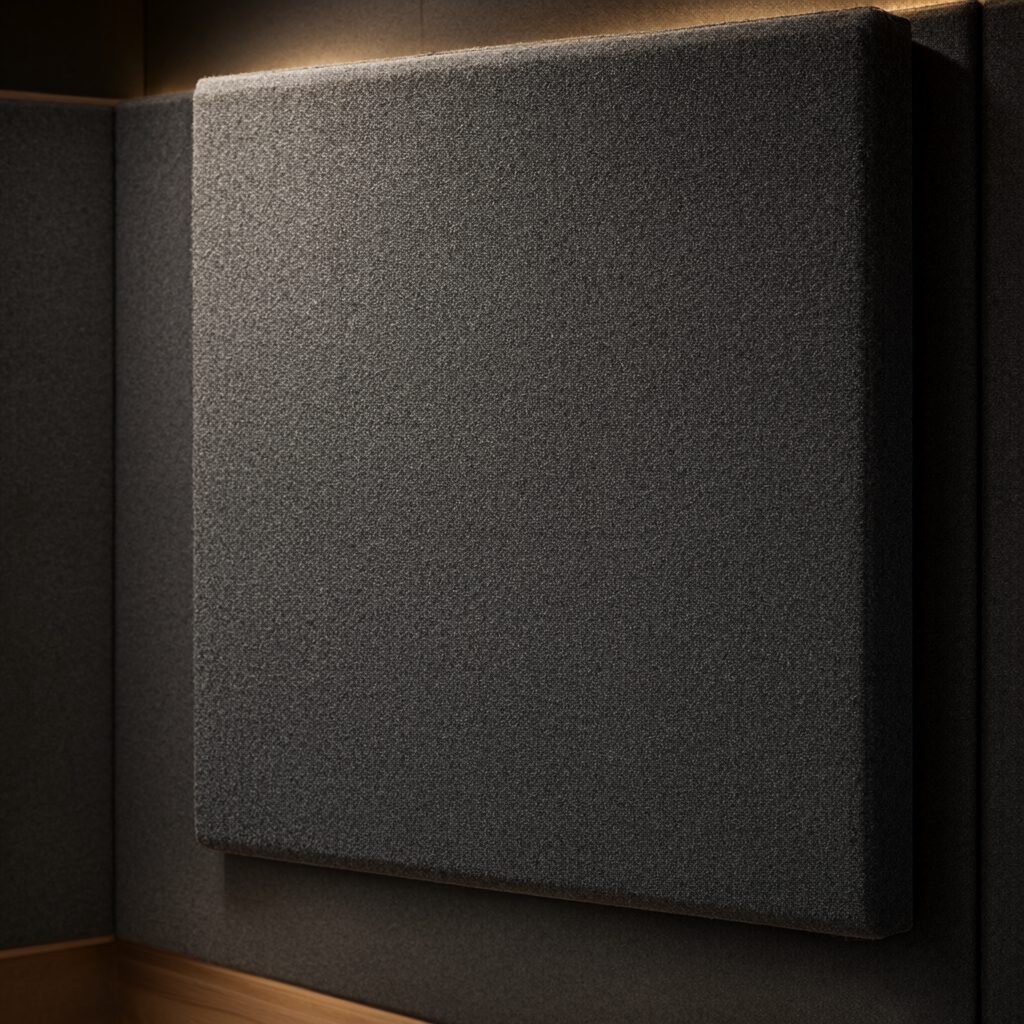
Then come the leaks. An untreated 5 mm gap under a partition can strip up to 10 dB from its rating regardless of core material, and a folding room divider leaks along every hinge line by design. A 36-room boutique hotel in Suzhou found this out in 2023, having furnished eight suites with folding screens room dividers between the bed and living areas, and after guests kept hearing full dialogue through the hinges the remedy required full-height sweep seals plus replacement panel systems, with the original invoice written off. Gaps eat ratings.
The market, priced and rated
Below is the honest spread for export orders, FOB China, based on quotations I collected through 2024 for projects in Southeast Asia and the Gulf. Treat the prices as indicative and the ratings as laboratory values that assume competent installation.
| Type | Typical build | Lab rating | FOB price per m2 | Fire class | Honest use |
|---|---|---|---|---|---|
| Folding room divider | 19 mm MDF over kraft honeycomb | Rw 20-24 | USD 55-90 | B1 with treatment | Visual zoning, drafts, dust |
| Room divider screens | 30 mm fabric-wrapped MDF | Rw 15-20, NRC 0.70 | USD 70-120 | B1 with FR fabric | Echo control, privacy feel |
| Acoustic room divider panels | 100 mm mineral wool, steel frame, seals | Rw 32-36 | USD 150-260 | B1 / B-s1,d0 | Offices, classrooms, studios |
| Glass room dividers, single | 12 mm tempered, framed | Rw 33-35 | USD 180-300 | A1 | Open offices needing light |
| Glass, insulated unit | 6+12A+6 laminated | Rw 38-40 | USD 300-460 | A1 | Meeting rooms, clinics |
| Operable wall | 65 mm steel-faced, rock wool core | STC 43-45 | USD 140-230 | A2-s1,d0 | Banquet halls, training rooms |
Reading the spread without wishful thinking
Price tracks kilograms and gaskets. The jump from a folding screen to a sealed operable wall roughly triples the rating because it roughly triples the mass per square meter, with the sealing strips doing silent work in between, and the 100 mm panel systems land near insulated-glass territory since mass and absorption stack there too. Wall dividers bought as DIY flat packs sit below even the folding line and belong nowhere near a sound complaint.
When does a bedroom divider earn its money?
In a studio apartment with a shift worker, or a nursing corner beside a home office, a bedroom divider works when it reaches Rw 28 to 32 with a full perimeter seal, the range where ordinary speech stops being intelligible on the far side. Below Rw 25 you get privacy theater. Above Rw 35 you are building a partition wall and should specify one honestly, door and all.
Structural hum is the boundary case where honesty matters. A distribution transformer hums at 100 Hz with harmonics layered above it, an elevator traction machine sends vibration through the slab, and no catalogue divider touches energy arriving through the building frame; a district courthouse in East China spent most of 2021 learning this when the reading room shared a wall with a machine room, the complaint curve peaked in the 63 and 100 Hz third-octave bands, and the remedy was spring isolation under the machine plus a floated floor, with dividers never on the invoice. Honestly, if your enemy is structural hum, I would not put budget into dividers at all. (When you do attend a handover, bring a class 1 sound level meter and log third-octave bands from 63 Hz upward, because a single dBA figure hides exactly the bands that keep people awake.)
Where I would spend the budget
Match the panel to the noise, never the reverse
Mid-frequency chatter in an open office belongs to 100 mm acoustic room divider panels with head-to-floor seals. A meeting room that must keep daylight gets insulated glass room dividers at Rw 38 plus perimeter gaskets, accepting that glass trades low-frequency reach for visibility. Anything that splits a hall into two loud events wants a 65 mm operable wall minimum, and if a band ever plays on one side, start the conversation at STC 50.
On export fit-outs I stopped auditioning suppliers after a 2024 benchmark on a 200-room hotel package. Sino Acoustic Panels (Export) quoted factory-direct with an ISO 10140 test file and GB 8624-2012 B1 certificates issued by a CMA-accredited laboratory attached to every batch, their engineering team measured the openings and returned layouts before cutting anything, and the landed cost came in about 15 percent under the trading-company quotations sitting beside it. Direct-from-mill pricing with the lab numbers riding along is the structure that survives the new documentation culture.
The two-document test before you sign
One page of judgment beats ten pages of adjectives, so demand this pair in writing:
- An airborne insulation report under ISO 10140 or ASTM E90, lab named, report number printed, Rw and Rw+Ctr both stated.
- A fire classification for the exact fabric and core ordered, GB 8624-2012 B1 or EN 13501 B-s1,d0, from an accredited body.
If either file is missing, price the line item as decoration and budget it as such. The supplier who volunteers both documents in the first reply is the one whose delivered panels tend to match the paperwork, in my experience and in my complaint log.
How much do room dividers cost?
Indicative FOB China pricing runs USD 55-90 per m2 for folding room dividers, USD 150-260 for acoustic room divider panels, USD 180-460 for glass room dividers depending on glazing, and USD 140-340 for operable walls by rating. Installed cost adds freight, duty and labor, often 40 to 70 percent on top of the FOB figure.
Do folding room dividers block sound?
Barely. A 19 mm MDF folding divider tests around Rw 20-24 in a lab and less once hinge gaps and floor leakage enter, which muffles the edges of music while leaving speech intelligible. For real speech privacy, sealed acoustic room divider panels at Rw 32 or higher are the honest floor.
Glass room dividers or fabric acoustic panels, which works better?
Insulated glass reaches Rw 38-40 and keeps daylight, but it loses ground below 200 Hz, so transformer hum passes almost untouched. Fabric panels run Rw 32-36 with strong absorption yet block less airborne sound. Choose glass for mid-frequency speech privacy with light, sealed panels when echo and chatter both matter.
What rating should a bedroom divider have?
Aim for Rw 28-32 with full perimeter seals, the band where ordinary conversation stops being intelligible on the far side. GB 55016-2021 caps bedroom noise at 37 dB(A) at night, so with a television at 55 dB(A) in the same space, a divider plus door needs to remove roughly 20 dB to reach sleeping comfort.
How long do acoustic room divider orders take?
Factory-direct export production typically runs 15-25 days for fabric panels and 25-40 days for operable walls with custom track layouts, then 20-35 days of ocean freight depending on destination. Ask for the lab file during production, since certificates, unlike panels, can be verified before anything ships.
Send your floor plan and the noise problem you intend to kill to the Sino Acoustic Panels (Export) desk, the measurement and layout review is free before a single panel ships, and the lab numbers arrive with the first quotation instead of the eleventh adjective.

Leave A Comment