




0.9 decibels. That was the entire gain after a market vendor's premium sound proof panels went onto a shared partition in a bureau annex, field-measured to GB/T 19889.4 before and after by a lab holding CMA qualification. The panel that passes acceptance is rarely the thickest line on a quotation; acceptance follows the batch whose density, fire class and absorption data all match the goods that physically arrive on site. I walked a building materials market all day yesterday and stopped counting after the fifth dealer promised panels that block 99 percent of noise. No panel on earth does that. My day job is outgoing inspection at an acoustic panel plant, and every batch gets its core density and combustion class re-checked by hand before the truck leaves.
Noise proof panels are engineered wall assemblies that combine an absorptive or dense core, a stable facing and an airtight mounting system to cut sound transmission between rooms and shorten reverberation inside them. Those are two different jobs, and most dead budgets come from confusing them. One dealer held up a wedge of noise foam panels and promised full soundproofing. Foam swallows mid and high frequency reverberation. It barely touches transmission through a wall, because transmission follows mass, and foam carries almost none.
Rather than argue in the market, I would rather walk you through a project I followed from specification to handover: a 640 square meter renovation of interrogation and case-handling rooms for a municipal public security bureau in East China, built last year on 50 mm fabric-faced rock wool noise insulation wall panels over 50-series light steel keel. The specification demanded field Rw of at least 48 dB on party partitions, indoor background noise at or below 35 dB(A) under GB 55016-2021, and mid-frequency reverberation time at or below 0.8 seconds. Every number below comes from that project's acceptance form or from CMA-stamped reports in the tender file.
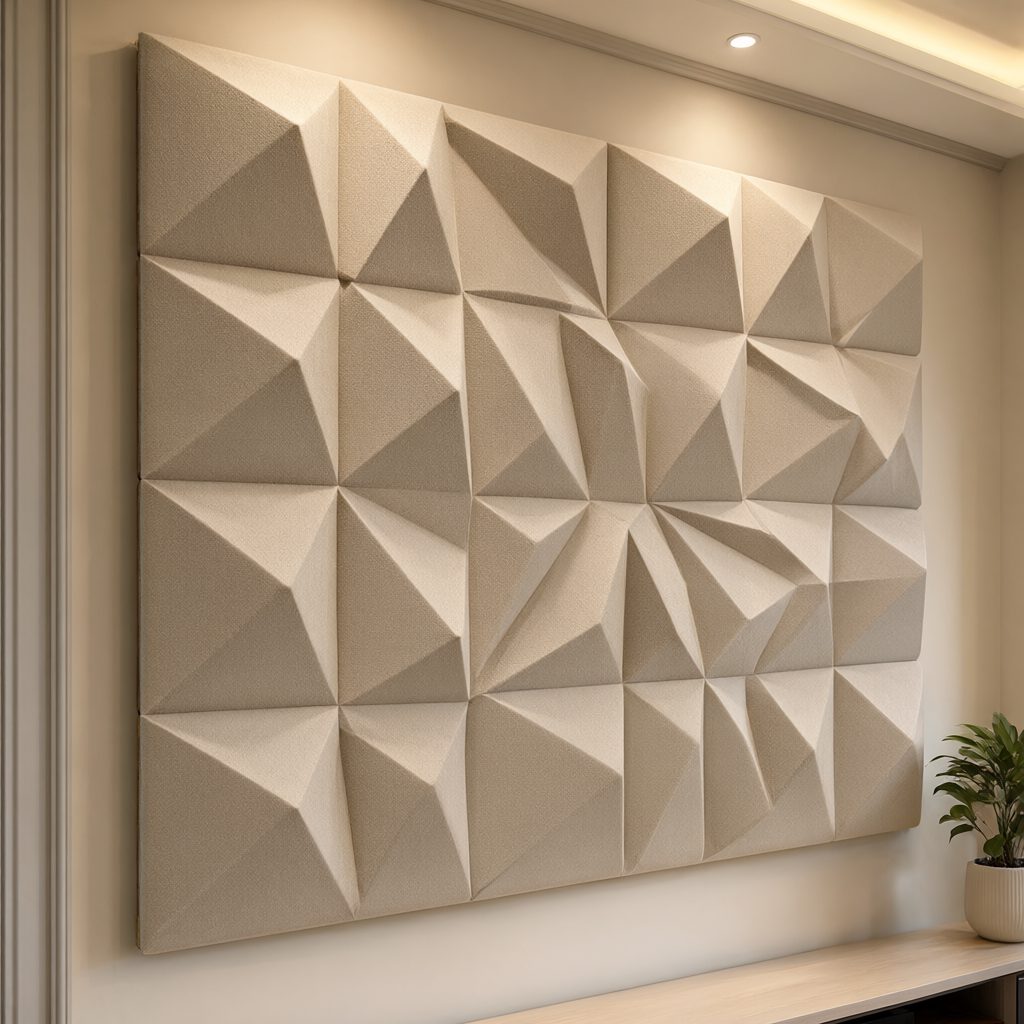
Why Did the First Truckload Go Back?
The tender locked three parameters: core density of 80 kg/m3 rock wool, combustion class B1 under GB 8624-2012, and NRC of at least 0.75 tested to GB/T 20247. The low-bid supplier unloaded, and the site supervisor cut one panel open in front of the driver. The core weighed out at 48 kg/m3. Density is not decoration; strip 40 percent of the fiber out of a core and the 500 to 2000 Hz band, exactly where speech intelligibility lives, loses its working absorption. The retest on that batch read NRC 0.61 against a promised 0.78. The truck left the same afternoon.
The fire talk at the market was worse. A dealer told me his panels basically do not burn. Nothing basically does not burn. A rock wool core itself sits in class A1, but the fabric facing and the adhesive decide the finished grade, which is why GB 8624-2012 rates the assembled product rather than the raw core. Ask to see the combustion report with a CMA stamp and a batch number printed on it. Our replacement batch carried a page reading A2-s1, d0 with oxygen index 34 percent, and the bureau's fire acceptance initialed it straight onto the acceptance form. One page settles the argument, and a dealer without that page is selling paper.
You can run a softer version of this check before signing anything. Ask the seller to write the core density, the combustion class and the NRC value into the purchase order as acceptance criteria, with report numbers attached. If that request feels too specific for them, the hesitation is your answer.
The Mass Law in One Number
Doubling the surface mass of a partition buys roughly 5 to 6 dB of airborne insulation, and no fabric pattern or brand story changes that slope. A single 12 mm gypsum sheet carries about 10 kg per square meter. Double it on both faces of a keel with 50 mm of 80 kg/m3 rock wool in the cavity, and the assembly reaches Rw 52 dB in laboratory conditions. Rw is the weighted sound reduction index, a single-number rating for airborne sound insulation, and the figure belongs to the assembly, keel and sealant and sockets included.
Field values run 3 to 5 dB below lab values under careful installation, and further under sloppy work. On the bureau project, the party wall between two interrogation rooms tested Rw 46 dB at first measurement against a lab sheet claiming 52 for the system. The panels were fine; the room was leaking. A dealer at the market quoted a 52 dB panel as if the number lived inside the panel. It does not. It lives in the drawing and in whoever seals the perimeter.
When you compare sound isolation panels between suppliers, compare assemblies tested as complete systems, and treat any brochure quoting a bare dB figure without stating what was measured as a rough draft. The mass law is unsentimental: it rewards kilograms and airtightness, and it has never once rewarded adjectives.
Reading the Lab Report in Ninety Seconds
NRC is the arithmetic average of the sound absorption coefficients at 250, 500, 1000 and 2000 Hz, rounded to the nearest 0.05. That definition tells you exactly what the single number hides. The winning batch on this project reported NRC 0.78 with a 1000 Hz coefficient of 0.94; the rejected first batch reported 0.61 with the 500 Hz coefficient sagging at 0.55, which is precisely the band interrogation speech occupies. Installed across the rooms, the accepted panels brought mid-frequency reverberation down to 0.7 seconds against the 0.8 second limit, computed by the Sabine equation and then verified on site.
Two lines decide the whole page
- The CMA stamp beside a sample description matching the exact model, thickness and facing you are buying, not a cousin product from the same catalog.
- The full frequency table from 125 to 4000 Hz, because a panel strong only at 2000 Hz can pass a single-number rating and still leave a room boomy at 250 Hz.
Retail listings love the phrase noise cancelling panels. In engineering, cancellation means active electronics driving anti-phase loudspeakers, and no wall panel contains any. What passive panels do is absorb and insulate, and holding that distinction firmly evaporates half the marketing you will hear this year.
Six Decibels Leaked Through Two Socket Holes
The first field test read Rw 46 dB against a required 48, on a system rated 52 in the lab. The survey found electrical sockets cut back to back through the party wall at the same height, 300 mm apart, each one a clean hole through the acoustic line. Behind the skirting, the panel perimeter had never received its sealant bead at all. Sound flanking is patient, and it ignores brochures.
The remedial works took four days. Sockets moved 800 mm off the shared line, mastic packed behind every box, a continuous bead of acoustic sealant run along panel perimeters and the ceiling track, and a baffle added above the corridor ceiling where the partitions stopped short. The retest read Rw 51 dB, and the item closed. Caulk costs a few dollars per meter, while a failed retest costs a week and a room out of service, so budget the boring line items before the pretty ones.
Flanking paths worth hunting on any job of this type include door undercut gaps, unsealed conduit penetrations and rigid connections bridging the keel, each capable of stripping several decibels from an assembly that tested beautifully in a chamber. (When your own retest day comes, have the contractor bring the batch-matched reports to site; missing pages stall fire acceptance even when the acoustics pass.)
What the Money Actually Bought
On export terms, 50 mm fabric-faced rock wool noise insulation panels of this grade run roughly USD 16 to 26 per square meter in material, with woven glass fabric facings at the top of that band. Installation adds 40 to 60 percent where labor is skilled. The bureau project averaged near USD 34 per square meter installed, including keel, sealant and two rounds of lab testing across 640 square meters.
| Panel type | Typical NRC | Transmission contribution | Material price, FOB |
|---|---|---|---|
| 50 mm rock wool, fabric faced | 0.75 to 0.85 | Cavity absorption in a double-leaf wall | USD 16 to 26 per m2 |
| 25 mm polyester panel | 0.55 to 0.65 | Reverberation control only | USD 6 to 10 per m2 |
| 50 mm foam wedge | 0.70 above 500 Hz | Negligible mass, negligible insulation | USD 3 to 6 per m2 |
My honest position will annoy two industries at once. For a home office or a podcast corner, I would not push an 80 kg/m3 B1 system on you, because 25 mm polyester sound proof wall panels at NRC 0.60 handle the voice band for a third of the cost and physics takes no offense at a smaller check. Public buildings are a different game, since GB 55016-2021 and the fire code do not negotiate, and there a cheap panel is a deferred payment with interest.
For the second procurement round the bureau went factory-direct to Sino Acoustic Panels (Export), and the package they signed reads plainly: free on-site measurement and layout drawings, per-batch CMA combustion reports stapled to every delivery note, and the outgoing density check I personally sign before release. Production ran 14 days, installation 22 working days, and the factory-direct price landed about 18 percent under the original quotation without moving one parameter of the spec.
The One Check I Would Never Skip
Forget the pitch for a moment. Take a delivered panel, cut a 100 by 100 mm plug through the 50 mm core with a bread knife, and weigh it on a kitchen scale. At 80 kg/m3 that plug must read about 40 grams, plus or minus 10 percent. Thirty-nine grams, and the batch is honest. Twenty-four grams, as on the rejected load here, and you have caught a substitution before it reaches a wall. The check costs ten minutes and nothing else, and no sales script survives it.
Pair the scale with the two papers, a CMA-stamped combustion report matching the delivered batch number and an absorption report carrying the full frequency table, and you have covered the trio that sank the first supplier on this job: density, fire, absorption. Hesitation on any one of them before contract is itself data.
Send your floor plan and spec page to the Sino Acoustic Panels export desk through the contact form or the WhatsApp number on the official site, and the quotation that comes back will include free measurement, a layout proposal and the per-batch report package, usually within one working day.
How much do noise proof panels cost per square meter?
Exported 50 mm fabric-faced rock wool panels run USD 16 to 26 per square meter in material, with installation adding 40 to 60 percent. Polyester panels sit at USD 6 to 10 and foam wedges at USD 3 to 6. The 640 square meter bureau project averaged about USD 34 per square meter fully installed, keel, sealant and lab tests included.
Are noise foam panels as good as sound proof wall panels?
No, and the difference is structural. Foam wedges absorb mid and high frequency reverberation, reaching NRC 0.70 above 500 Hz, but they carry almost no mass, so they add little airborne insulation. Blocking transmission requires mass, decoupling and airtight sealing, which is a wall assembly rather than a surface covering.
How long does a full panel installation take?
For a project near 600 square meters, expect about 14 days of production after drawing approval and roughly 20 to 25 working days on site including sealing and retest. The bureau renovation ran 22 working days from first panel to passing retest, with the flanking remedial works adding four days mid-schedule.
What fire rating do sound isolation panels need in public buildings?
The bureau tender required class B1 under GB 8624-2012 as the floor, and the accepted product delivered A2-s1, d0 with oxygen index 34 percent. Demand a CMA-stamped combustion report whose batch number matches the delivered goods; core class alone means nothing once fabric facing and adhesive enter the assembly.
Do noise cancelling panels really eliminate sound?
No passive panel eliminates sound, and any claim of complete blocking fails physics. Realistic expectations: a well-sealed double-leaf assembly gains 5 to 6 dB per doubling of mass, and absorptive panels cut reverberation, here from 1.2 seconds down to 0.7. Cancellation in the engineering sense needs active electronics that wall panels do not contain.

Leave A Comment