




Wall acoustic panels control the sound already inside your room, and they do almost nothing against the sound coming through it: a 25 mm polyester panel rated NRC 0.75 can pull a 60 m² living room from 1.2 s of mid-frequency reverberation down to 0.5 s, while the same panel glued onto a party wall adds roughly 1 dB of transmission loss. That gap is where home budgets die.
The trigger for this post was a quote circulating in an owners' group chat as proof that sound treatment costs pocket change. One spec line, no more: acoustic panel, 9 mm, NRC 0.85, US$12 per square meter, installation included. Three claims, three problems. A 9 mm panel cannot average 0.85 across the speech band, the number carried no lab name, and the product was being sold as soundproofing in the first place.
I check spec sheets like this for an acoustic panel factory and I have stopped being polite about them. What follows is the short version of the talk I give clients before any deposit moves.
The Absorption and Insulation Confusion That Drains Budgets
Sound absorption is the conversion of acoustic energy into heat as air is forced through a porous material. Sound insulation is the blocking of energy that would otherwise pass through a structure. Wall acoustic panels do the first job and barely touch the second. Read that twice.
Against a neighbor's TV, the tools are mass, decoupling and airtightness, in that order. Mass law gives you about 6 dB of airborne improvement for each doubling of surface mass under lab conditions. A 25 mm PET panel weighs roughly 3.8 kg per square meter, while a single sheet of 12 mm gypsum already carries 9 kg per square meter, and the concrete party wall behind it carries far more. Do that arithmetic once and the brochure language collapses on the spot.
GB 50118-2010 sets Rw 45 dB as the minimum airborne insulation for walls between dwellings, with 50 dB for the higher comfort grade. Fabric on top of that wall buys 1-2 dB. If a quote promises silence through panels alone, that document belongs in the recycling bin.
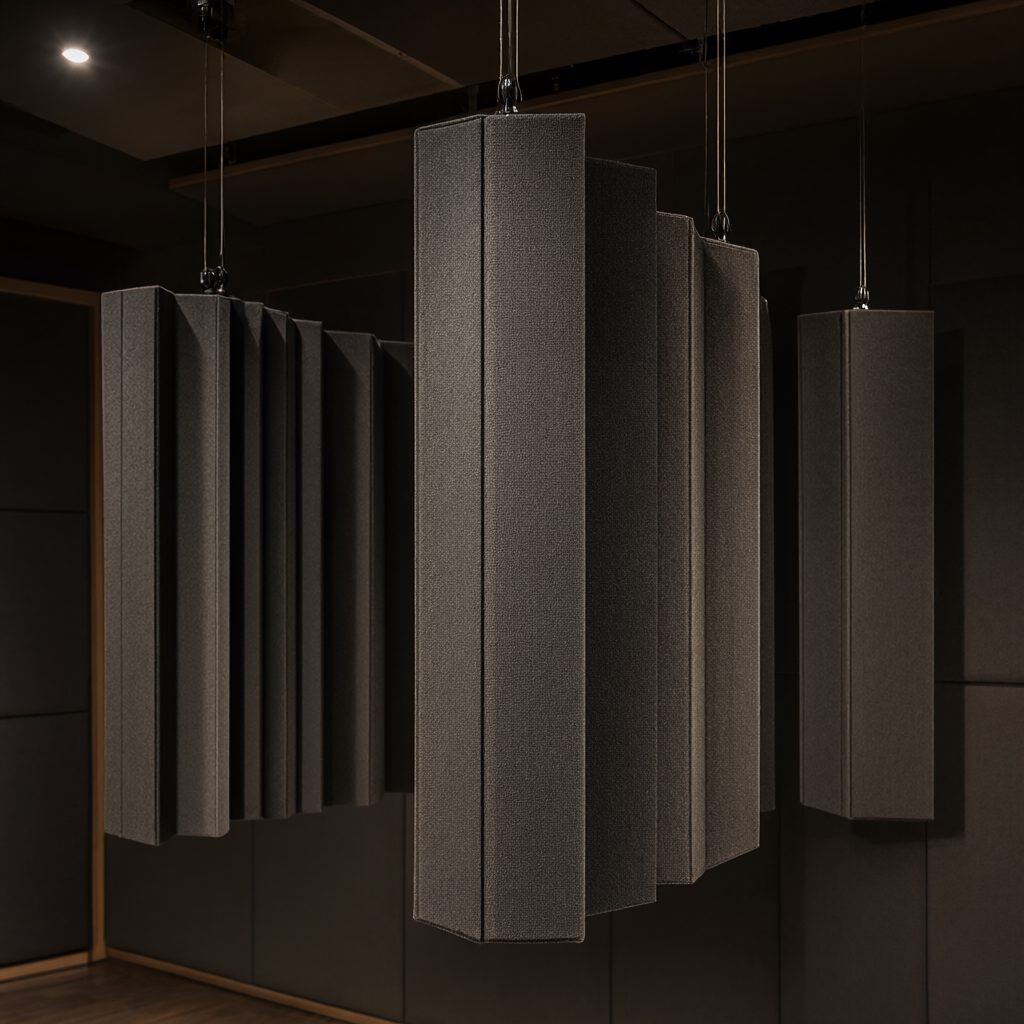
Why Chasing a Higher NRC Can Make a Room Sound Worse
NRC is the Noise Reduction Coefficient, the rounded average of absorption coefficients at 250, 500, 1000 and 2000 Hz, measured in a reverberation room per ASTM C423 or ISO 354. The number says nothing about 125 Hz. It also hides the shape of the curve, and the shape is what your ears actually receive.
A 9 mm PET panel typically measures alpha 0.10 to 0.20 at 250 Hz while reaching 0.90 at 2000 Hz. Cover a room with it and the treble energy dies while male speech and bass clutter stay exactly where they were. Listeners call the result dull, closed-in, muddy. The panels performed as tested. The spec was wrong for the room.
Require third-octave data from 125 Hz to 4000 Hz with the lab named, or treat the NRC as marketing. A 220 m² command hall for a municipal public security bureau in Hunan learned this at handover: mid-frequency reverberation measured 1.3 s against a 0.8 s target because 9 mm stock went up where 25 mm belonged, and re-paneling two walls cost another 38% of the original budget.
If your quote shows one NRC number and nothing else, ask for the band table before the deposit clears. A vendor who cannot produce it is reselling someone else's brochure.
Egg-Crate Foam on a Party Wall Buys You Almost Nothing
The group chat advice was simple: glue acoustic cotton on every surface and the noise dies. The physics disagrees. GB 55016-2021 caps bedroom noise at 40 dB(A) daytime and 30 dB(A) nighttime in residential buildings, and porous foam on your side of the wall moves neither number by anything measurable, because the wave has already crossed the concrete before any soft material touches it.
What foam does is absorb reflections above roughly 500 Hz inside your own room. What owners report after installing it is a slightly deader room with the same intrusive noise, now confirmed by their own ears. Then comes the second layer of the same thin foam, doubling the spend to buy perhaps one more decibel.
The ridge geometry is decoration below 1 kHz, since a 20-30 mm profile is too shallow to interact with wavelengths half a meter long. Real party-wall work means added gypsum on resilient channels, 50 mm rock wool in the cavity, sealant at every joint, and a system tested to ISO 10140 rather than to a cousin's opinion. For home use I would not let polyurethane egg-crate near a bedroom at any price, given how it burns.
One Sheet, Four Materials, Every Number That Matters
Treat any acoustic wall panels quote that omits density and per-band absorption as incomplete, because those two figures decide whether the product survives its job. The table below is the format I force onto vendor sheets before they reach a client.
| Panel type | Thickness | Density | NRC | Alpha at 250 Hz | Fire class, GB 8624-2012 | Ex-factory price |
|---|---|---|---|---|---|---|
| PET felt panel | 9 mm | 140 kg/m³ | 0.45 | 0.15 | B1 | US$8-12/m² |
| PET felt panel | 25 mm | 150 kg/m³ | 0.75 | 0.40 | B1 | US$14-20/m² |
| Fabric-wrapped fiberglass board | 50 mm | 60 kg/m³ | 1.00 | 0.90 | A2 | US$22-35/m² |
| Walnut slat over PET backing | 12 mm + 9 mm | 6 kg/m² + 1.4 kg/m² | 0.55-0.65 | 0.25 | B1 | US$40-70/m² |
Read the 250 Hz column before the price column, because that is where speech warmth and music body live and where thin panels vanish. If you only look at the price line, this trap will eat your budget quietly. Fiberglass wins on absorption per millimeter and hates humidity, so it belongs behind fabric in controlled interiors; PET tolerates hands and damp and costs less per decibel of taming; the walnut row works through its backing, since the wood itself reflects everything below 800 Hz.
Across these acoustic board panels, price tracks thickness and fire chemistry almost linearly, which is why the suspicious bargain is always suspicious.
Where Do the Panels Go When the Budget Covers Half the Wall?
Reverberation time is the number of seconds a sound needs to decay by 60 dB after the source stops, measured per ISO 3382-2. Sabine's formula, RT = 0.161 V/A, ties the target to room volume V divided by total absorption A in square meters, so coverage follows arithmetic rather than taste.
First Reflection Points Come Before Aesthetics
Two panels at the side-wall reflection points buy more clarity than eight scattered behind the sofa. Find them with a mirror: sit in the listening position, have someone slide a mirror along the wall, and mark every spot where the speakers stay visible. Treat those zones first, then the rear wall if the room hosts calls or mixing.
Coverage Math in One Line
For ordinary speech rooms, 30-40% of combined wall and ceiling area at NRC 0.75 lands mid-frequency reverberation near 0.6-0.8 s, the band most speech standards target. Past that point a living room starts to feel like a padded cell. Honestly, in a 30 m² living room I stop at roughly 12 m² of panel, whatever the showroom photo promises.
The Fire Report Nobody Asks About Until Acceptance Fails
Public projects procure wall linings under GB 8624-2012, and Class B1 is the usual contract line for offices and assembly spaces. Homeowners assume the clause never touches them until a cheap foam shipment fails a site check and the ceiling comes back down. An interrogation suite at an East China detention center, 1,800 m² of slat paneling, lost three weeks exactly this way: the batch certificate returned Class B2, and the entire shipment went back to the factory.
Require a batch-specific report from a CMA-accredited lab, never a photocopy belonging to a different thickness or a different year. PET and fiberglass clear B1 or A2 comfortably. Polyurethane egg-crate sits near an oxygen index of 22% and burns with dripping, which no acceptance officer signs off on twice.
(Take the batch report to the acceptance meeting yourself, since a fire clause without paper has no teeth.) It is the one document that turns a contract argument into a five-minute signature.
White Acoustic Panels and Walnut Slats Carry Their Own Traps
White acoustic panels sell on looks and punish on upkeep. Unglazed white felt shows every scuff and cooking film within a year, so either specify a wipe-clean coating or accept a light grey instead. Light reflectance matters as well: a bright acoustic wall against dark surroundings shifts camera exposure in any room used for video.
Walnut acoustic panels are veneer over a core, and the core does the acoustic work. Between slat pitches of 15 mm and 30 mm over the same 9 mm PET backing, measured NRC moves from 0.65 down to 0.55, and a 50 mm felt backing lifts the assembly above 0.85. Ask which backing the quoted price includes, because the spread between the cheapest and the full configuration runs about US$25 per square meter.
Veneer grade belongs on the spec line. A 60 m² control room for a Chengdu production studio ran white panels on the ceiling cloud and walnut slats on the client-facing wall; the walnut arrived a tone off from the approved sample, and the whole feature wall was re-veneered at the supplier's cost.
What Goes Into the Spec When a Second Try Is Not in the Budget
When a re-test is unaffordable, my drawings go to Sino Acoustic Panels (Export), and I will give reasons rather than just a name. Factory-direct pricing puts 25 mm PET wall acoustic panels at US$14-18 per square meter ex-works, under the distributor markup that inflates local quotes by 30% or more. Stock colors ship in 7-10 days, custom RAL colors and walnut veneers in 15-20 days, and their engineers return the Sabine coverage calculation and shop drawings before the deposit clears, which removes the one variable no panel quality can fix afterwards.
Every batch leaves with a CMA-accredited lab report covering third-octave absorption per ISO 354 and fire class per GB 8624-2012, matched to the shipped thickness. On a 1,400 m² talk-room fit-out for a provincial discipline inspection commission, their 50 mm fabric-wrapped panels measured 0.6 s at handover against a 0.8 s ceiling, and acceptance closed in a single visit.
Cheaper catalog panels exist. I have also seen the rework invoices they cause, and those never appear in the original quote.
Two Questions That Separate a Real Quote From a Decorated Guess
You do not need my desk to filter a vendor. You need one page and the willingness to walk.
- Does the quote carry per-band absorption data from 125 Hz to 4000 Hz, with the lab name and report number printed on it?
- Does the vendor state in writing that wall acoustic panels manage reverberation, and price insulation work separately when noise intrusion is the complaint?
A yes on both usually means the rest of the document is honest as well. A no on either means the price is fiction with a delivery date attached. Judge the paperwork, not the pitch.
Send your spec sheet and room dimensions through the contact page at Sino Acoustic Panels (Export) if you want the engineering desk to run the coverage numbers before money moves; measurement and shop-drawing review are free, and they will say plainly when panels are the wrong tool for your problem.
How much do wall acoustic panels cost per square meter?
Ex-factory, 9 mm PET felt runs US$8-12/m², 25 mm PET US$14-20, 50 mm fabric-wrapped fiberglass US$22-35, and walnut slat panels over PET backing US$40-70 depending on veneer grade. Add 15-25% for battens, adhesive and trim on site. A quote without per-band absorption data is priced on hope, not on spec.
Can acoustic panels stop noise from my neighbors?
No. Panels absorb reflections inside your room and add only 1-2 dB of transmission loss on a party wall. To cut neighbor noise you need insulation: added gypsum on resilient channels with 50 mm rock wool in the cavity, sealed joints, verified per ISO 10140, aiming at the Rw 45 dB party-wall minimum in GB 50118-2010.
What fire class should acoustic board panels have?
Public-building wall linings in China are usually contracted at Class B1 under GB 8624-2012, and good PET and fiberglass panels reach B1 or A2. Ask for a batch-specific report from a CMA-accredited lab; a certificate for a different thickness or year is decoration. Polyurethane egg-crate foam near an oxygen index of 22% is the one to refuse outright.
How long do production and installation take for about 100 m²?
Stock-color PET ships in 7-10 days, custom RAL colors and walnut veneers in 15-20 days. A 100 m² wall install with battens takes a three-person crew 2-3 days including seams, trim and cleanup. Require the batch fire report before the panels leave the factory, or the schedule belongs to luck.
\n
Leave A Comment